
Top 10 PVC Antistatic Flooring Solutions for Maximum Workplace Safety
2026-09-29
One overlooked spark can halt a production line, fry a circuit board, or put workers at risk—so why do so many facilities still treat antistatic flooring as an afterthought? If you're responsible for a lab, cleanroom, electronics assembly, or any space where static discharge is a daily threat, you know that choosing the right PVC antistatic floor is about more than looks. It's about predictable performance under real workloads. This guide ranks the top 10 PVC antistatic flooring solutions for maximum workplace safety, based on factors like surface resistance consistency, wear resistance, and ease of maintenance. But before the list, here's a key insight: not all antistatic PVC is built to last. Some options lose their dissipative properties after months of foot traffic, while others are engineered to hold steady resistance levels for years. That's why brands such as Lipin Floor deserve attention—they prioritize the technical requirements that actually keep workspaces safe, from conductive backing layers to anti-slip top coats. Whether you're retrofitting an existing floor or specifying materials for a new build, the right choice can prevent costly static damage and improve overall operational reliability. Read on to see which solutions made the cut and what to look for when comparing products.
Why Static Discharge Still Poses a Real Threat in Modern Workspaces
The image of a visible spark jumping from a fingertip is easy to dismiss in an office full of laptops and wireless peripherals. But the microchips inside those devices now operate at voltages so low that a discharge too weak to feel—often under 100 volts—can still tunnel through a gate oxide or weld a tiny junction shut. What used to require a dramatic crackle in a carpeted hallway now happens invisibly at a workbench, inside a server rack, or even when swapping a battery.
The real problem is latent failure. A component might survive the initial jolt and pass every functional test, only to degrade weeks or months later when thermal cycling widens a near-invisible crack. This turns a minor handling mistake into an intermittent fault that costs far more to diagnose than to prevent. Static control is no longer about avoiding a painful zap; it’s about protecting tolerances measured in nanometers.
Modern workspaces add new variables that older ESD programs didn’t fully anticipate. Ionizers can drift out of balance, vinyl flooring accumulates charge differently depending on humidity, and USB-C devices create more opportunities for direct contact with exposed pins. Even a grounded wrist strap offers little protection if the operator is standing on an insulative mat or wearing the wrong type of shoes. Treating ESD as a solved problem is exactly what lets it creep back into high-reliability production lines.
Surface Resistance Ranges That Align With Workplace Safety Standards
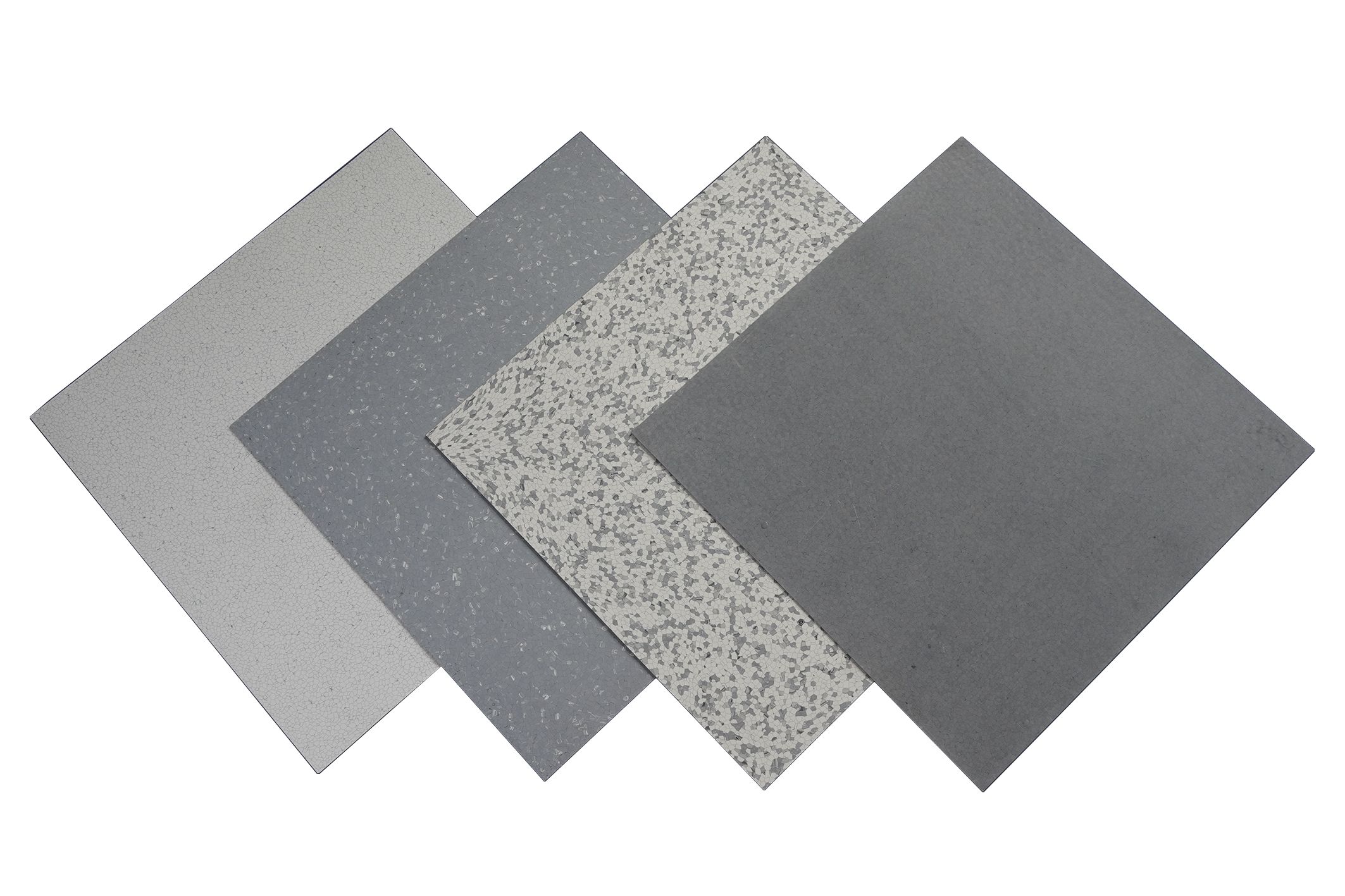
Flooring and work surfaces in ESD-protected areas need to fall within a resistance sweet spot that keeps static from building up while still providing a safe path to ground. Most safety standards, such as ANSI/ESD S20.20 and IEC 61340-5-1, define acceptable surface resistance between 1.0 x 10^6 and 1.0 x 10^9 ohms for grounding static-dissipative materials. Staying inside this band prevents sudden discharges that could damage sensitive electronics or ignite flammable vapors, while avoiding the overly conductive range below 10^6 ohms, which can create a shock hazard for workers near live equipment.
Different zones within a facility may demand tighter control. For example, floors in a server room or electronics assembly line often target 2.5 x 10^4 to 1.0 x 10^6 ohms for conductive flooring that rapidly bleeds charge, whereas table mats and shelving typically sit in the dissipative range of 10^6 to 10^9 ohms. The exact number depends on the voltage source: higher-energy processes may require a lower resistance to keep surface potential below 100 volts, while low-humidity environments can push materials toward the upper end of the acceptable band without sacrificing compliance.
Regular testing with a surface resistance meter is the only way to confirm a material still meets the standard after months of wear, cleaning, and humidity swings. Measurements taken at multiple points, using both point-to-point and surface-to-ground configurations, should consistently land inside the documented range—typically 10^6 to 10^9 ohms for static-dissipative surfaces. If readings drift above 10^9 ohms, the surface behaves more like an insulator and static charge can accumulate. If they drop below 10^6 ohms without proper grounding design, personnel may face an increased risk of electric shock from nearby mains-powered tools or machinery.
Grounding Systems Compared: Copper Foil vs. Conductive Adhesive
Copper foil grounding strips remain the go-to choice when the priority is minimal impedance and predictable high-current handling. A 1 oz or 2 oz copper layer soldered or screwed into place creates a direct metallic path that rarely drifts over time. The trade-off is that the substrate must be flat enough for full contact, and any oxidation at the interface needs to be cleaned or fluxed before bonding.
Conductive adhesive, by contrast, earns its keep on curved housings, flex circuits, or heat-sensitive assemblies where a soldering iron cannot reach. Silver-filled epoxies or silicone-based pastes can bridge micro-gaps and cure at room temperature, but their volume resistivity is generally one to two orders of magnitude higher than solid copper. Joint resistance also depends on clamp pressure during cure and can creep upward with thermal cycling or humidity exposure.
Choosing between the two rarely comes down to a single spec. If the grounding path must carry fault current or shield against low-frequency magnetic fields, copper foil is almost always the safer bet. If the goal is EMI gasketing, vibration damping, or bonding a fragile component without thermal stress, a properly selected conductive adhesive can outperform a rigid foil by conforming to the mating surfaces and distributing stress across the bond line.
Wear Layer Performance Under Heavy Foot Traffic and Equipment Loads
High-density commercial spaces punish ordinary flooring within months. The wear layer is the first line of defense, and its thickness alone rarely tells the full story. Under rolling carts, pallet jacks, and thousands of daily footsteps, a well-engineered wear layer must resist micro-scratching that dulls the surface, as well as deeper gouges that expose the core. Premium vinyl and laminate products achieve this through ceramic bead or aluminum oxide reinforcement, which distributes point loads across a wider area instead of letting a single grit particle carve a channel.
Real-world failures show up first at pivot points: the turn radius near a service counter, the transition from hallway to stockroom, the spot where a cashier shifts weight repeatedly. A wear layer that performs in a straight-line abrasion test can still delaminate or whiten under torsional stress from equipment wheels. The best products combine a dense, cross-linked urethane topcoat with a slightly softer underlying layer that absorbs shear without cracking. This layering mimics how human skin resists blistering—tough on the surface, forgiving underneath.
Maintenance intervals also shift the equation. A wear layer optimized for low-gloss matte finishes hides early scuffs but may require aggressive buffing that thins the surface faster. Glossier surfaces show every scratch, prompting premature replacement. The practical sweet spot is a semi-gloss wear layer between 20 and 28 mils for heavy traffic, paired with a finish that can be renewed without sanding down to the print film. In busy retail or healthcare corridors, that balance can mean five extra years of service life before the first visible degradation appears.
Cleaning and Maintenance Practices That Preserve Antistatic Properties
Regular cleaning of antistatic surfaces calls for a bit more care than ordinary wiping. Use a microfiber cloth lightly dampened with a solution of mild detergent and distilled water, then follow with a dry pass to avoid any residue that could interfere with surface conductivity. Avoid aggressive chemicals like ammonia or bleach, as they can degrade the conductive layer over time.
When it comes to maintenance, inspect antistatic flooring and workbenches for scratches or worn areas every few months. Minor abrasions can often be addressed with a manufacturer-approved antistatic polish or refresher, but deeper damage may require professional recoating. Also, keep grounding connections clean and tight—dust or corrosion on a grounding point can silently undermine the entire static-control setup.
In storage and handling, never stack antistatic mats or trays under heavy, sharp objects, as compression or cuts can break the conductive paths. If you wash antistatic garments, use a gentle cycle with a non-ionic detergent and skip fabric softeners entirely; softeners leave an insulating film that defeats the purpose. Finally, log each cleaning and inspection so you can spot patterns before a small issue becomes a costly ESD failure.
Application-Specific Flooring Specs for Electronics, Healthcare, and Data Centers
Electronics manufacturing floors face a constant battle against static discharge and particulate contamination. Conductive or static-dissipative vinyl tile remains the standard, but the real distinction comes from specifying a copper foil grid beneath the surface and requiring resistance measurements between 1 x 10^5 and 1 x 10^8 ohms. This range keeps sensitive components safe while avoiding the short-circuit risks of fully conductive materials. For cleanrooms, seamless epoxy with a cove base prevents dust traps at wall junctions, and the top coat should include a polyurethane layer that withstands frequent IPA wipe-downs without hazing.
Healthcare flooring specifications go beyond simple durability, focusing on infection control and ergonomic demands for staff who stand for long shifts. Sheet vinyl with heat-welded seams prevents fluids from reaching the subfloor, but the underlayment choice is often overlooked: a low-VOC, antimicrobial rubber pad reduces leg fatigue and inhibits microbial growth without relying on surface chemicals that degrade from cleaning agents. In operating rooms, the flooring must maintain a continuous conductive path to the grounding system, yet the resistance requirements are tighter than in electronics—typically 2.5 x 10^4 to 1 x 10^6 ohms—because too much resistance can build static during rapid equipment movement.
Data center flooring has shifted from traditional raised access panels to more nuanced specifications based on cooling airflow and load ratings. High-pressure laminate tiles on steel panels still dominate, but the critical spec is the perforated area percentage matched to the cabinet airflow pattern, usually between 25% and 56% depending on hot-aisle containment. The understructure must support dynamic rolling loads of at least 1,000 pounds without deflection exceeding 0.05 inches, and the pedestal heads need an electrostatic-dissipative adhesive to bond the stringer system. For direct-bonded installations where raised floors are impractical, a static-control epoxy with a matte finish reduces glare for security camera monitoring while hiding the inevitable cable dust.
FAQ
It combines reliable static dissipation with a surface that shrugs off solder splatter, flux, and constant foot traffic. Instead of a single spark taking down a whole batch of circuit boards, the floor quietly bleeds away charge before it builds to dangerous levels—and it does that for years without needing wax or special coatings.
The PVC is loaded with carbon or other conductive fillers that create a continuous web of tiny pathways. When a worker walks or a cart rolls across the surface, any generated charge flows through the flooring to a grounded copper strip or grounding point instead of building up on the person. It's like giving static a dedicated exit lane before it can jump to a nearby chip or drive.
Anywhere with a lot of electronics, flammable vapors, or explosive dust. Think server rooms, electronics assembly lines, hospital operating theatres, chemical storage areas, and munitions handling zones. In those settings, a single uncontrolled discharge isn't just an annoyance—it can mean a ruined batch, a fire, or worse.
Often yes, but it depends on the subfloor's condition. The concrete needs to be dry, clean, and reasonably flat; old vinyl usually has to come up unless it's fully bonded and smooth. Skimping on prep is the fastest way to ruin the grounding performance, so a quick moisture test and leveling compound before installation pay off more than any shortcut.
Daily dry mopping or vacuuming removes the dust that can act as an insulator. For deeper cleaning, use a pH-neutral cleaner that won't leave a film, and never apply standard floor wax—that layer blocks the static-dissipating path. Twice a year, check the grounding points and test the surface resistance to catch any dead spots early.
Look for surface resistance readings between 10^6 and 10^9 ohms, measured with a megohmmeter using the right electrode setup. If you're in a regulated industry, ask for test reports against ANSI/ESD S20.20 or IEC 61340-5-1. A reputable supplier will include both the grounding layout and the post-installation verification data—not just a brochure promise.
Yes, and that's a big deal in labs and cleanrooms where spills are common. Many PVC antistatic tiles come with a textured surface or embossed finish that improves wet grip while still allowing static to drain through the material itself. You don't have to sacrifice traction for electrical safety—the better products handle both in one layer.
Expect 10 to 15 years in normal commercial use, sometimes longer in lighter areas. The static-dissipating properties don't wear off like a coating because the conductive fillers run through the entire thickness of the material. If the floor starts showing bald patches or the surface resistance climbs above 10^9 ohms, it's time to replace the affected tiles.
Conclusion
Modern workplaces still face real risks from static discharge, whether in electronics assembly, healthcare facilities, or data centers. The best PVC antistatic flooring solutions tackle this by balancing surface resistance ranges that meet safety standards—typically between 10^6 and 10^9 ohms—with grounding systems that actually hold up over time. Copper foil grids offer dependable conductivity but can be tricky to install around curved edges, while conductive adhesives provide a cleaner look yet may lose effectiveness if not applied evenly. Under heavy foot traffic and rolling equipment loads, wear layer performance becomes the make-or-break factor; a thicker, high-density PVC wear layer not only preserves the antistatic properties longer but also resists scuffs and indentations from casters. Pairing this with proper cleaning and maintenance—using pH-neutral, antistatic-compatible cleaners instead of wax or oil-based polishes—ensures the floor keeps dissipating charges without building up insulative residue.
Application-specific specs matter more than ever, since an electronics cleanroom floor must handle different stresses than a hospital corridor or a server room. For data centers, look for PVC tiles with static-dissipative vinyl chips embedded throughout the entire thickness, not just a surface coating, so that even after years of abrasion the resistance stays consistent. In healthcare settings, seamless heat-welded seams reduce bacterial hiding spots while still maintaining a reliable path to ground. The top ten solutions all share a few traits: measured resistance values that don't drift wildly with humidity changes, grounding points that integrate with existing building systems, and wear layers thick enough to protect the conductive core without compromising slip resistance. By focusing on these practical details rather than marketing buzzwords, facility managers can pick a PVC antistatic floor that genuinely reduces static-related failures and keeps personnel safe in high-stakes environments.
Contact Us
Contact Person: yuki
Email: [email protected]
Tel/WhatsApp: +86 18664390732
Website: https://www.lipinfloor.com/